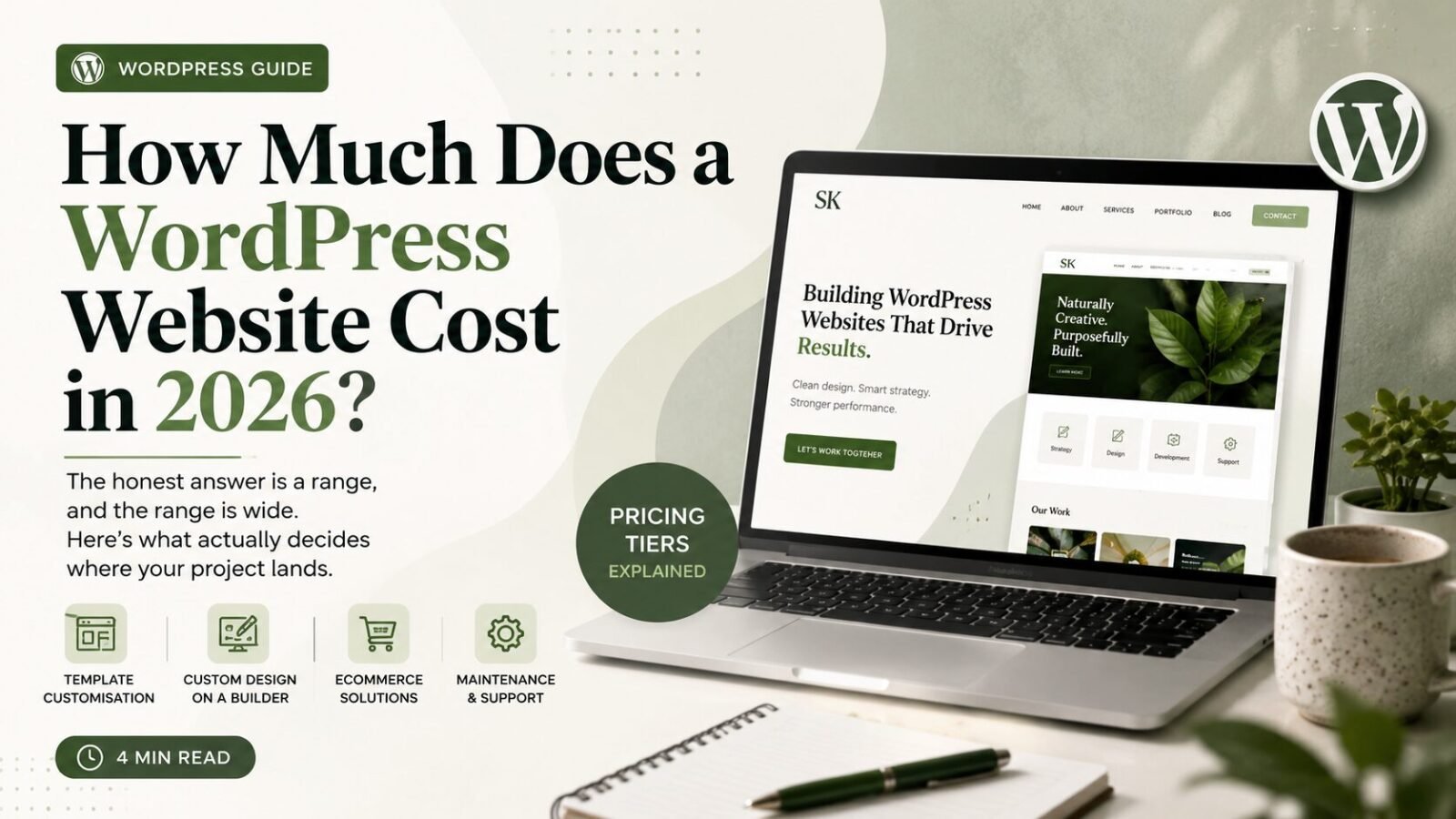
Every quote you receive for a WordPress site will be different, and the spread will be large enough to make you suspicious of all of them. That is not because someone is overcharging. It is because “a WordPress website” describes everything from a five-page template swap to a custom-built platform with a design system behind it, and those are not the same product.
Here is what the tiers actually contain, and what pushes a project from one to the next.
Template customisation: the low end
A pre-built theme, your logo and colours applied, your content in place. Five to eight pages. Two or three weeks.
This is a real option and it suits a real set of businesses: a new venture testing an idea, a local trade that needs a credible presence and a contact form, anyone whose customers arrive by referral rather than by search. If that is you, do not let anyone talk you into more.
What you give up is differentiation and control. Your site will resemble the other sites using that theme. Changing anything structural means fighting the theme’s assumptions. And you inherit the theme author’s code quality, which you cannot audit before buying.
Custom design on a builder: the middle
A design produced for your business, then built in Elementor, Bricks or the block editor. Ten to twenty pages, custom sections, a proper mobile treatment, basic on-page SEO.
This is where most small business projects sit, and for good reason. You get a site that looks like yours rather than like a template, editable by your team afterwards, without the cost of a fully bespoke build.
The variable that moves the price most here is not page count. It is how many genuinely different layouts exist. Twelve pages using four layouts is a much smaller job than eight pages using eight layouts, and any developer quoting properly will ask about that before giving you a number.
Fully custom: the top
Design in Figma first, then a custom theme with no page builder, custom post types and fields for structured content, a design system, animation, and performance built in rather than bolted on.
What justifies this is not vanity. It is a site that stays consistent as it grows, loads fast because nothing unnecessary is loading, and can be redesigned in three years without the content being trapped inside a page builder’s markup.
This tier makes sense when the site is a revenue channel rather than a business card, when several people will edit it, or when it will keep growing after launch.
Ecommerce sits on its own scale
A WooCommerce store is not a brochure site with a shop bolted on. Payment gateways, shipping rules, tax by region, stock management, the checkout flow, order emails, and the operational testing to prove all of it works before real money moves through it.
Product count matters less than product complexity. Two hundred simple products with one price each is straightforward. Twenty products with size, colour, bundle pricing and per-variant stock is not.
What actually moves the price
Content readiness. The single biggest hidden variable. If your copy and images are finalised, the build is fast. If they arrive in pieces over six weeks, the project stretches and stretched projects cost more. Some developers price this in. Some discover it later, and that conversation is unpleasant for everyone.
Integrations. A contact form is trivial. A booking system that writes to your calendar, a CRM sync, a members area, a multi-step quote calculator: each of these is its own small project.
Approval chain. One decision-maker is fast. A committee is slow, and slow costs money. If four people must approve the homepage, say so before you get a quote.
Migration. Moving an existing site means preserving URLs, redirecting what changed, and carrying content across without losing formatting. On a site with two hundred posts and years of rankings, this is careful work with real consequences if skipped.
The costs nobody puts in the quote
Hosting, renewed yearly. A domain. Premium plugin licences, which are almost always annual rather than one-off. And maintenance, which is the one people skip and then regret.
Maintenance is not optional in the way it sounds. WordPress, its plugins and PHP all update continuously. An unmaintained site is a site that will eventually break or be compromised, and emergency recovery costs more than a year of maintenance would have.
How to compare quotes without being misled
The cheapest quote and the most expensive one are usually describing different projects. Before comparing numbers, get each quote to answer the same four questions.
What exactly is being designed, and how many revision rounds are included? Is this a template or custom design? Who writes the content? What happens after launch, and what does it cost?
A quote that cannot answer those in writing is not a quote. It is a guess, and the difference will surface halfway through the build.
One thing worth paying for
Whatever tier you choose, pay for a proper discovery conversation before any code is written. An hour spent understanding what the site needs to do saves weeks of building the wrong thing. Any developer who wants to start building immediately, without asking what the site is for, is a developer whose quote you should treat cautiously.
If you want a number for your specific project rather than a range, the contact page is the fastest route, and you can see the kind of work each tier produces across the portfolio.
Frequently asked
Why do WordPress quotes vary so much for the same brief?
Because the brief rarely specifies the tier. A template customisation and a fully custom build are different products, and both are honestly described as a WordPress website. Ask each quote whether the design is template-based or custom, and the range narrows immediately.
Is a cheap WordPress site a false economy?
Not always. For a business whose customers arrive by referral, a well-built template site does the job. It becomes a false economy when the site needs to grow, rank, or be edited by several people, because those are the things a template resists.
What ongoing costs should I budget for after launch?
Hosting and domain renewal, any premium plugin licences, which are usually annual, and maintenance covering updates, backups and monitoring. Maintenance is the one most often skipped and the one that costs most when it is.
Does the number of pages decide the price?
Less than people expect. The number of distinct layouts matters far more. Twelve pages sharing four layouts is a smaller job than eight pages each needing their own.

Written by
Sehrish Khalid
WordPress Developer & UI/UX Designer. 7+ years, 500+ projects.